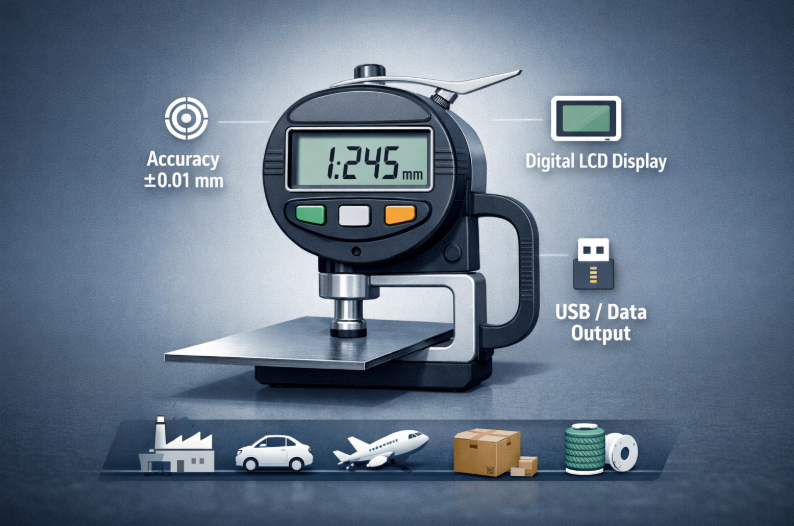
Digital Thickness Gauge Buying Guide: Features, Accuracy & Applications – Ultimate Expert Guide 2026
In today’s precision-driven world, accurate measurement is no longer optional it’s essential. Even a small deviation in material thickness can lead to product defects, safety risks, or regulatory non-compliance across industries.
Digital thickness gauges solve this challenge by delivering fast, reliable, and repeatable measurements. They help professionals maintain quality standards while reducing waste, downtime, and costly rework.
Why thickness measurement is critical:
- Ensures consistent product quality
- Prevents material failure and safety risks
- Supports compliance with industry standards
- Reduces scrap and production errors
What Is a Digital Thickness Gauge and How It Works
A digital thickness gauge is a precision measuring tool that uses electronic sensors to calculate material thickness and display it instantly on a digital screen. It removes guesswork by providing clear numerical readings with high resolution.
Compared to traditional gauges, digital models are easier to read, faster to use, and better suited for modern quality control and inspection environments.
Core components include:
- Anvil (fixed base)
- Spindle or probe (movable contact point)
- Electronic sensor
- Digital LCD display
Basic Measurement Principles
Most digital thickness gauges operate by applying controlled pressure between two contact points. When a material is placed between the anvil and spindle, the gauge measures the distance electronically.
Advanced gauges, such as ultrasonic thickness gauges, use sound waves to measure thickness without direct contact—ideal for coated or inaccessible materials
Measurement Methods Used
Digital thickness gauges rely on different measurement methods depending on the material, accuracy requirement, and accessibility of the surface. Each method has its own strengths and is suited to specific applications.
Understanding these methods helps users choose the right gauge for their industry, material type, and inspection environment.
Contact-Based Mechanical Sensing
Contact-based mechanical sensing is the most traditional and widely used measurement method. It works by physically placing the material between an anvil and a spindle, applying controlled pressure to determine thickness.
This method is highly reliable for flat, solid materials and is commonly used in workshops, laboratories, and production lines where direct access to both sides of the material is available.
Best suited for:
- Metal sheets and plates
- Paper, cardboard, and films
- Rubber and plastic components
- Routine quality inspections
Electronic Displacement Measurement
Electronic displacement measurement uses internal sensors to detect minute movements of the measuring probe. Instead of relying solely on mechanical movement, the displacement is converted into an electronic signal and displayed digitally.
This method improves resolution, repeatability, and consistency, especially when frequent or high-volume measurements are required.
Key advantages include:
- Higher measurement resolution
- Reduced operator influence
- Faster and repeatable readings
- Ideal for precision manufacturing
Ultrasonic Wave Transmission (Non-Contact)
Ultrasonic thickness measurement uses high-frequency sound waves that travel through the material and reflect back from the opposite surface. The time taken for the wave to return is used to calculate thickness.
This non-contact method is ideal when access to only one side of the material is possible or when the surface cannot be physically touched.
Common applications include:
- In-service inspections without dismantling
- Pipes, tanks, and pressure vessels
- Corrosion and wear monitoring
- Coated or painted materials
Digital vs Analog Thickness Gauges
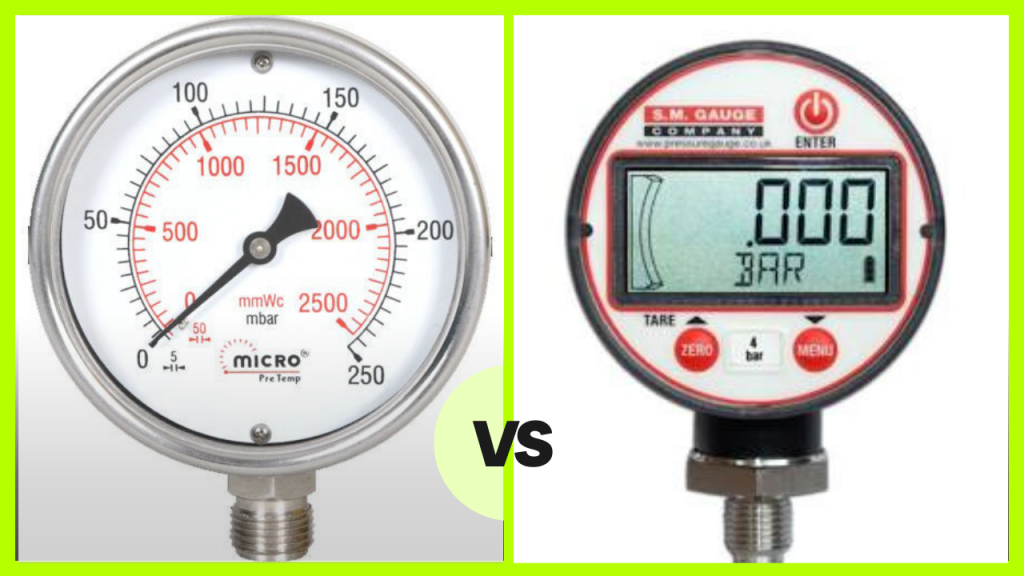
Digital thickness gauges clearly outperform analog models in terms of speed, accuracy, and ease of use. Their digital displays remove common reading errors caused by dial interpretation, poor lighting, or parallax issues.
Although analog gauges are still used in some basic applications, most modern industries now rely on digital gauges for their efficiency, repeatability, and ability to handle data-driven quality control processes.
Key Advantages of Digital Gauges
- Instant, Easy-to-Read Measurements
Digital gauges display measurements clearly on an LCD screen, eliminating guesswork and reducing operator error during inspections. - Higher Resolution (Up to 0.001 mm)
High-resolution sensors allow digital gauges to detect extremely small thickness variations, which is critical in precision manufacturing and quality control. - Data Storage and Export Options
Many digital gauges can store readings internally or export data via USB or wireless connections, improving traceability and reporting. - Simple Calibration and Zero-Setting
Digital models allow quick zero-setting and calibration, ensuring consistent accuracy with minimal setup time.
Key Features to Look for in a Digital Thickness Gauge
Choosing the right digital thickness gauge depends on understanding which features directly affect your measurement needs. Not all gauges are suitable for every material, environment, or accuracy requirement.
By focusing on essential features, users can achieve better performance, longer tool life, and reliable results across different applications.
Must-Have Features to Consider
- Measurement Range and Resolution
Determines the minimum and maximum thickness the gauge can measure and how fine the measurement increments are. - Display Clarity and Size
A clear, well-lit display improves readability and reduces eye strain, especially in industrial or low-light conditions. - Data Connectivity Options
Connectivity allows measurements to be transferred to computers or quality systems, reducing manual errors and improving efficiency. - Build Quality and Durability
A robust design ensures the gauge can withstand frequent use and harsh working environments without losing accuracy.
Measurement Range and Resolution
The measurement range defines how thick or thin a material the gauge can accurately measure. Thin materials such as films and foils require high resolution, while thicker materials need a wider measuring range.
Resolution becomes especially important in industries where small thickness changes can affect product performance, safety, or compliance with standards.
Typical Specifications Explained
- Measurement Range: 0–10 mm or Higher
A wider range allows the gauge to handle both thin and thick materials, making it more versatile across applications. - Resolution: 0.01 mm or 0.001 mm
Higher resolution enables more precise readings, which is essential for high-tolerance industries like aerospace and electronics. - Adjustable Measuring Force for Soft Materials
Controlled measuring force prevents deformation when measuring soft or flexible materials such as rubber or plastic films.
Understanding Accuracy, Precision, and Repeatability
Accuracy, precision, and repeatability are often used interchangeably, but they describe different aspects of measurement performance. Understanding these concepts is essential when evaluating a digital thickness gauge for professional use.
A gauge that performs well in all three areas delivers reliable results, reduces measurement uncertainty, and supports consistent quality control.
Accuracy Standards Explained
Accuracy describes how close a measured value is to the true or actual thickness of a material. Manufacturers usually express accuracy as a tolerance, such as ±0.02 mm.
Meeting the correct accuracy standard ensures compliance with industry regulations and prevents measurement-related defects.
- Manufacturer-Specified Tolerance
Indicates the maximum allowable deviation from the true value under defined conditions. - Industry Standard Compliance
Accuracy should align with standards used in industries such as aerospace, automotive, or medical manufacturing. - Reference to Metrology Standards
Accuracy fundamentals are based on established metrology principles used worldwide.
Calibration and Zero Setting
Calibration ensures that a digital thickness gauge continues to provide correct measurements over time. Without proper calibration, even high-quality gauges can drift and produce inaccurate readings.
Zero setting is equally important, as it establishes a correct baseline before measurements begin.
Key Calibration Features
- Automatic Zero Setting
Allows the gauge to reset to zero instantly, reducing setup time and human error. - External Calibration with Gauge Blocks
Uses certified reference blocks to verify and adjust accuracy. - User-Adjustable Calibration Modes
Enables fine-tuning based on material type or measurement conditions.
Factors That Affect Measurement Accuracy
Several external and operational factors can influence thickness readings. Recognizing these factors helps users minimize errors and improve consistency.
Controlling these variables is especially important in high-precision or regulated environments.
Common Accuracy Influencers
- Surface Roughness
Uneven surfaces can prevent full contact between the gauge and material. - Operator Pressure
Excessive or inconsistent force can compress soft materials and distort readings. - Temperature Variations
Heat expansion or contraction can affect both the material and the gauge. - Material Elasticity
Flexible materials may deform under pressure, altering measured thickness.
Types of Digital Thickness Gauges
Different applications require different gauge designs and measurement methods. Selecting the correct type ensures accurate results and efficient operation.
Understanding the main gauge types helps users match the tool to their specific inspection needs.
Contact Thickness Gauges
Contact gauges measure thickness by placing the material directly between two contact points. They are the most commonly used and cost-effective option.
- Direct Contact Measurement
Requires access to both sides of the material. - High Accuracy for Flat Materials
Ideal for uniform sheets and components. - Simple and Affordable Design
Suitable for routine inspections and quality checks.
Ultrasonic Thickness Gauges
Ultrasonic gauges measure thickness using sound waves, making them ideal when direct contact or backside access is not possible.
They are widely used for inspection and maintenance in industrial settings.
- Single-Side Access Measurement
Only one surface needs to be accessible. - Non-Destructive Testing
Does not damage or alter the material. - Ideal for In-Service Inspection
Used for corrosion and wear monitoring.
Coating Thickness Gauges
Coating thickness gauges are designed specifically to measure paint, plating, or coatings applied to metal surfaces.
They are essential in industries where coating thickness affects performance, protection, or appearance.
- Paint and Coating Measurement
Measures thickness without damaging the coating. - Metal Substrate Detection
Works on steel, aluminum, and other metals. - Industry-Specific Use
Common in automotive, aerospace, and construction sectors.
Applications Across Different Industries
Digital thickness gauges are used wherever material consistency and dimensional accuracy are critical. Their versatility makes them valuable across many sectors.
Each industry relies on thickness measurement for safety, performance, and quality assurance.
Manufacturing and Quality Control
Thickness gauges verify that materials meet design and production specifications.
- Incoming Material Inspection
Confirms raw materials meet required tolerances. - In-Process Quality Checks
Detects defects early during production. - Reduced Waste and Rework
Prevents out-of-spec materials from advancing.
Automotive and Aerospace
Precision and traceability are critical in these industries, where safety and performance are non-negotiable.
- Structural Integrity Verification
Ensures parts meet strength requirements. - Aerodynamic and Weight Control
Maintains tight thickness tolerances. - Regulatory Compliance
Supports documentation and audits.
Metalworking and Fabrication
Metal components must meet exact thickness tolerances before processing.
- Material Verification Before Cutting
Prevents errors during fabrication. - Welding and Assembly Preparation
Ensures consistent joint quality. - Final Inspection Checks
Confirms finished parts meet specifications.
Plastics, Rubber, and Packaging
Flexible materials require careful measurement to avoid deformation.
- Low-Force Measurement
Prevents compression of soft materials. - Film and Foil Thickness Control
Ensures packaging consistency. - Molded Part Verification
Confirms uniform wall thickness.
Paper, Textile, and Film Industries
Thickness consistency directly affects appearance, strength, and performance.
- Non-Destructive Testing
Preserves material integrity. - High-Speed Production Checks
Supports continuous monitoring. - Improved Product Uniformity
Enhances quality and customer satisfaction.
How to Choose the Right Digital Thickness Gauge
Choosing the right gauge depends on material type, environment, and compliance requirements. A well-matched gauge improves efficiency and measurement reliability.
Evaluating these factors before purchase helps avoid costly mistakes.
Based on Material Type
- Soft Materials
Choose low-force contact gauges to prevent deformation. - Hard Materials
Select robust, high-accuracy gauges for consistent results. - Coated or Inaccessible Materials
Use ultrasonic gauges for non-contact measurement.
Based on Measurement Environment
- Laboratory Environments
Prioritize resolution, stability, and precision. - Shop-Floor Environments
Focus on durability, ease of use, and fast readings.
Based on Budget and Compliance Needs
- High-End Gauges
Offer advanced features and traceability. - Mid-Range Models
Provide excellent performance for general use. - Compliance Requirements
Always match accuracy and calibration needs to industry standards.
Common Mistakes to Avoid When Buying
Many buyers select gauges without fully considering long-term needs. Avoiding common mistakes ensures better performance and satisfaction.
Frequent Buying Errors
- Choosing Based on Price Alone
Low-cost gauges may lack accuracy or durability. - Ignoring Calibration Requirements
Leads to unreliable measurements over time. - Selecting the Wrong Measurement Range
Limits versatility and usability. - Overlooking Data Output Needs
Reduces efficiency in quality reporting.
Frequently Asked Questions (FAQs)
Conclusion
Choosing the right thickness measurement tool is a strategic decision that impacts quality, compliance, and efficiency. By understanding features, accuracy requirements, and application-specific needs, buyers can make informed choices that deliver long-term value.
This Digital Thickness Gauge Buying Guide: Features, Accuracy & Applications provides a complete foundation for selecting the right instrument with confidence. Whether you’re in manufacturing, inspection, or research, the right gauge ensures precision you can trust.